

How do you get rich in Canada and become a Canadian millionaire?
It’s a question many Canadians have thought about at some point in their financial journey.
Getting rich in Canada’s current economic landscape can be quite intimidating amidst contentious issues like housing affordability, fluctuating interest rates, and recent spikes in inflation.
Though the financial hurdles that Canadians have to deal with have increased as of late, I believe that the fundamentals of growing wealthy remain the same.
It’s first important to understand that there are many different paths you can try taking to become rich in Canada. The path to take can be highly individual, and will depend on your financial goals, career path, available time, and risk tolerance.
For example, some methods like starting your own business involve higher risk and uncertainty, and typically require a combination of dedicated effort, specialized skills, and good fortune to succeed.
However, there’s a much more consistent way to get rich – a systemized approach to becoming a millionaire.
Here we’re going to focus on tried and true fundamentals that have stood the test of time. If you’re looking for a realistic and actionable approach to building long-term wealth, then you’re in the right place.
I’m going to walk you through a simple and replicable five step process to becoming wealthy that nearly anybody can follow.
Step 1: Identify Your Core Why
It’s great to have the ambitious goal of becoming rich.
But first, it’s essential to establish a clear and meaningful purpose that you can return to in your pursuit of becoming a Canadian millionaire.
For example, do you want to…
- Stop worrying if you have enough money to pay your next bills?
- Have the option to retire from a 9-5 job you dread going to?
- Be able to pursue your true passions and spend more time with the people you love?
You see, there will be times in your journey when things will inevitably get difficult.
Unexpected expenses and life events can happen out of the blue. Roadblocks will arise that challenge your resolve and commitment, and you’ll question yourself along the way.
Without a clear purpose or goal in mind, it’s easy to give in and give up, deviate from your long-term plans, and rationalize overspending when things get rough.
So take some time to thoroughly think about why you want to become rich. Keep asking why to try to uncover the trail of “whys” until you reach your core motivations.
Once you have established the why that resonates with you, you’ll be much more likely to stay the course, as demonstrated by the goal setting cycle below. When you do hit a period of burnout, you can refocus by remembering your core whys to get back on the right track.
Reidentifying with your purpose will time and time again allow you to keep disciplined when it comes to sticking to your long-term financial plans.

As an example, the “whys” that resonates with me is being able to provide a financially independent lifestyle for myself and my loved ones, having time flexibility and the option to choose what I want to do on the day to day, and travel the world.
Identify your whys and the wealth building process becomes a whole lot easier to commit to!
Step 2: Set Your Target
Let’s get on the same page about what it means to be wealthy.
Wealth can be measured using different benchmarks and metrics. For example, some measure wealth by net worth (everything you own minus everything you owe), some by liquid assets (such as a stock investment portfolio), and others care more about annual income.
I argue that the point of wealth is where you reach financial independence – when you no longer have to work for the rest of your life to support your desired lifestyle.
Setting a target that works for you requires consideration of several factors, such as your earnings potential, your ideal lifestyle and associated expenses.
Your target, at minimum, should be set at a point where you could be financially independent – that is, when you can comfortably pay off your monthly expenses for the rest of your life with the passive income generated by your invested savings (more on this later).
A common target benchmark is to have 25x your annual expenses invested into the stock market. This allows you to withdraw about 4% of your investments per year (also known as the 4% rule) to fund your lifestyle, with a high likelihood of not running out of money.
Not everybody will have the same target, and it’s up to you to determine how much you need to live a happy and comfortable life. Whether that means creating a nest egg of a few hundred thousand or a few million is up to you.
Here are some potential net worth targets you could set to reach financial independence, depending on your individual preferences and circumstances:
| Net Worth Target | Potential Annual Income using 4% Rule |
|---|---|
| $ 500,000 | $ 20,000 / year |
| $ 1,000,000 | $ 40,000 / year |
| $ 2,000,000 | $ 80,000 / year |
| $ 2,500,000 | $ 100,000 / year |
| $ 5,000,000 | $ 200,000 / year |
As a personal example, I have set a retirement target at $2 million. Using the 4% rule, I estimate that an investment portfolio of this size could reasonably generate around $80,000/year in passive income through the index investing strategy discussed in Step 4. Your target could be higher or lower depending on your desired lifestyle.
Setting specific targets also lets you track progress and see the “finish line”. If you plan on living below your means for a while in order to save at a quicker rate, seeing yourself make progress toward your targets can be incredibly motivating, especially when compounding interest starts doing more of the work in helping you reach your goals.
You’ll also want to set out a timeframe to reach that goal. It can also be beneficial to create shorter-term milestones to break progress down into more manageable chunks.
If you’re uncertain right now about the exact target you want to set, that’s okay. You can set a general target range and refine it over time.
Step 3: Allocate A Savings Budget
Fortunately, a high employment income isn’t a prerequisite for this wealth building approach.
Sure, it may help reduce the timeline to become financially independent, but the answer isn’t to “just find a higher paying job” in order to get rich in Canada.
That’s because for the vast majority of people, becoming wealthy can be accomplished regardless of how much you’re making every year.
The key lies in consciously and consistently allocating a portion of your after-tax income to saving and investing.
This is an important concept that can’t be stressed enough.
Again, it’s not that employment income doesn’t matter. All else equal, a higher income is obviously advantageous, but only if you’re saving proportionately and know how to manage issues like lifestyle creep.
The problem is that for most people, a higher income leads to instant lifestyle inflation. It’s more enticing to spend your bonus on a brand new car or a lavish vacation instead of using the opportunity to save more to reach financial independence sooner.
As a result, most times a paycheque after immediate expenses is blown on short-term wants.
Look no further than those who come across a sudden large windfall, such as lottery winners. How do they manage their surplus of money?
Unfortunately, it is widely cited that 1/3rd of all lottery winners end up declaring bankruptcy.
It’s clear that rather than having high income, it’s much more important to understand how to save, invest, and manage your wealth.

Accumulating long-term wealth starts with being intentional about how much you save relative to your income.
The simple truth is that the more you can set aside to save, the faster you’ll get rich in Canada and enjoy your life of financial freedom.
However, there is something important to be said about striking an appropriate balance between living frugally and living in the moment.
I would argue that it’s possible to take it too far to the extreme.
You definitely don’t want to save at the cost of being miserable every day until you finally reach your target. I believe that it’s also important to do your best to appreciate the journey of life on the road to financial independence.
It’s more about being mindful that you’re actually spending on the things that truly matter to you and improve your quality of life.
A good tip is to focus your spending on experiences rather than material wants. Experiences such as travelling are unique to each person and can’t be readily be compared like a house or car can.
The point is to practice purposeful, conscious spending on the things that make you the most happy, and to get rid of the habit of buying things that you don’t need that only bring temporary gratification.
An Example of High Income vs. High Savings
To really drive home the differences in financial impact between having a high income and a high savings rate, consider the following hypothetical financials of Adam and Bob.
Adam makes $100,000/year after taxes and spends 90% of his paycheque while saving the rest. He is left with $10,000/year to invest.
Bob only makes $60,000/year after taxes, but saves 40% of his income because he minimizes his discretionary spending and instead chooses to save it instead. Bob is left with $24,000/year to invest!
Admittedly, for many years Adam will be enjoying a far superior lifestyle compared to Bob.
However, Bob is saving at a higher rate. Soon enough, Bob will have a drastically higher net worth than Adam, simply because he saved more of his income.

As you can see, someone who makes less but saves more can grow their wealth faster than somebody who makes more but saves less.
Hopefully this insight will allow you to appreciate how important saving is to truly accelerate your path to getting rich in Canada and achieve financial freedom.
If you’re still tempted to spend your disposable income instead of saving it, here’s another way to frame the trade-off: assuming a 7% annual return, $1,000 saved and invested today will be worth $7,612 in 30 years, and $14,974 in 40 years.
That means if you’re 25, every dollar saved and invested today could be worth 15x more in your retirement portfolio by 65!
So, make a mental note: if you choose to spend money on something today, you’re foregoing the opportunity to buy something much more valuable for yourself later down the road.
Three Saving Strategies
Now that you understand the importance of saving, it’s time to dive into some practical saving strategies that you can start implementing right away.
Setting money aside for savings is part of the budgeting process, and is usually tied to when you receive the money, such as from your paycheque.
When it comes to budgeting a portion of your paycheque to save, there are three different approaches that you can take. Each approach has its own set of advantages and disadvantages.
As your financial circumstances change over time, you can adjust how you save along the way to accommodate your own individual situation.
Strategy 1: Save A Fixed Amount Every Period

This is one of the most straightforward ways to get started saving. Simply determine a target amount of money to save, and how often you want to save.
For example, suppose you just turned 18 and wanted to max out your Tax-Free Savings Account (TFSA) contribution room of $7,000. You could decide to invest $580/month into your TFSA over 12 months. The great thing with a TFSA is that any investment profits you make (such as from capital gains or dividends) are tax-free.
To combat the issues of saving at a fixed dollar amount, I would suggest to regularly adjust the amount you save as your circumstances evolve.
Strategy 2: Save A Percentage of Your After-Tax Income

If you’re more serious about getting rich in Canada, you should consider creating a budget that allocates savings as a percentage of your after-tax income.
To help remain diligent with your savings, you should always pay yourself first – before you spend on anything else, ensure you set aside a percentage of your paycheque to savings. Then, portion the rest to paying your bills and expenses, and treat yourself with the remainder.
Here are some potential saving allocations you could use depending on your preferences.
Modest Saving (20% of after-tax income)
This is a conventional approach to saving that aligns with the 50/30/20 rule of budgeting. The rule of thumb is to allocate 50% of after-tax income to pay for basic necessities and expenses. 30% goes to whatever you’d like, such as entertainment or luxury goods. The remaining 20% is saved towards retirement.
This option is best suited to those who want to retire with a comfortable amount of savings, but still want to experience life in the moment are not concerned about racing towards financial independence as fast as possible. They just want to get there eventually.
Aggressive Saving (40% or more of after-tax income)
This option is for people who are willing to sacrifice more of their excess income now to achieve financial independence quicker.
If you are committed to saving a substantial amount of your earnings, this is an excellent savings strategy to follow. You can even save more than 40% of your after-tax income if you can afford to. It really depends on your own income and expenses, as long as you can sustain yourself!
By saving aggressively, you will accumulate wealth at a rapid pace. I would recommend most people who are serious about financial independence to follow this savings strategy. With this approach, you’re essentially converting much of your would-be spending to savings instead.
Regardless of the proportion of income that you save, saving by percentage has its own set of benefits and drawbacks.
Strategy 3: Keep Spending Fixed And Save The Rest

This method is for those who are willing to do whatever it takes now to reap the rewards later down the road.
To achieve financial freedom sooner rather than later, you need to maximize your wealth in the long term. This requires living below your means. If saving is your primary objective and you’re willing to live a more frugal lifestyle to grow your net worth, this option is for you.
Going with this approach means keeping your voluntary spending stable regardless of your income. Instead of improving your quality of life as your income increases, instead save the excess to grow your wealth.
By saving all that you possibly can, you’ll be able to maximize the effects of compounding returns on your net worth.
If you do try this approach, it’s not going to be easy. You’ll probably experience some fear of missing out (FOMO) when you see your friends buying the latest gadgets and going on nice vacations, while you appear to have nothing to show for.
But only you can see your bank account and investments growing.
Here’s a tip to get into the right mindset: you know that you could afford to buy it if you wanted, yet you choose not to.
To me, enjoyment comes from the freedom of choice – not the choice itself!
Now that you’ve learned of the various ways you can structure your savings allocation, pick the one that suits you best and stick to it. Consistency and diligence will enable you to reach the financial targets that you’ve set!
Step 4: Don’t Just Save Your Money – Invest It
Now that you have your savings plan, it’s time to put your hard-earned dollars to work.
Savings is only one side of the wealth equation – investing your savings is the other.
It’s not enough to just park all your cash in a traditional savings account.
Sure, saving accounts are great for funds you know you’ll need to use soon, or as a place to park your 6 month emergency fund.
However, these accounts are not meant for long-term savings, and do not help to grow your wealth since you’ll be earning next to no interest income. Typically, banks offer measly savings interest rates ranging from 2% all the way down to 0% in interest per year.
You won’t even be able to keep up with inflation, and the real value of your money will actually decrease!
Most people who have a long savings time horizon (5 years or more) should take advantage of the higher expected returns that the stock market has to offer.
Most importantly, investing in the market allows you to enjoy the magic of compounding returns.
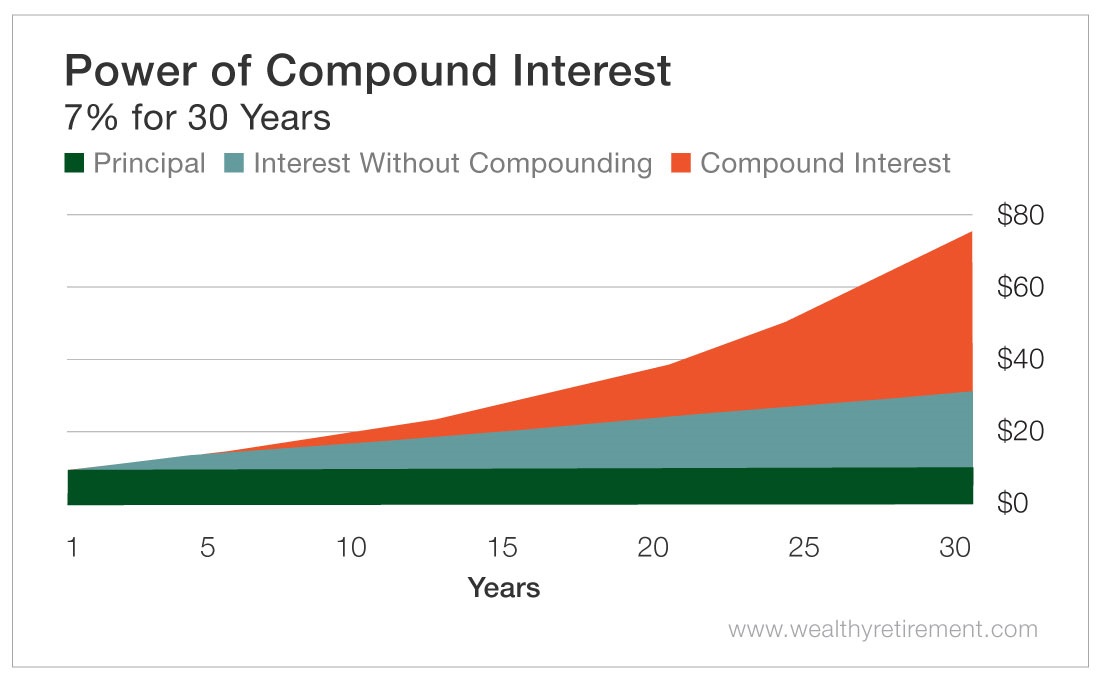
As you can see, compounding returns make a huge difference in your portfolio in the long run, and it is one of the main appeals of investing.
In fact, after many years of investing, it’s not uncommon to have almost all of of your investment portfolio made up of profits as a result of compounding returns!
Capitalize On Long-Term Compounding Returns
Due to the nature of exponential returns, the earlier you’re able to start, the better.
If you’re in your 20’s or 30’s and looking for the simplest way to get rich in Canada over a few decades, it’s as easy as investing into an all-in-one ETF within a Tax-Free Savings Account (TFSA) until retirement.
But even if you’re starting out your investing journey later in life, it’s never too late to get into the stock market.
Investing in exchange-traded funds (ETFs) is known as index investing, where you essentially buy the entire stock market in one go.
You don’t need to be a stock picking expert to do this. Best of all, it’s a strategy that generally outperforms individual stock picking while being much less of a time commitment.
Let’s say you’re 25 today and want to retire at 65 with the equivalent of $1 million in today’s dollars. If you invested just $12.50/day into an index fund tracking the S&P 500 until you were 65, then based on historical returns averaging around 7% (adjusted for inflation), you would have around $1 million saved up at retirement, tax-free.

I’ve used 7% as a benchmark return for long-term index investing, but is this a fair assumption?
The S&P 500 index has returned approximately 10% annually since the index was formed almost 100 years ago. This comes out to ~7% after adjusting for inflation.

As you can see, the overall stock market is making money far more often than it’s losing money.
But take a look at some of the sharp negative yearly returns, and you might be a little concerned. Think about the 2000-2002 dot-com bubble and the Great Recession of 2008, where stocks plummeted 38.49% in a single year. What if you invested right before a stock market crash?
The important thing to understand is that maximizing time spent invested in the market is the greatest hedge against the short-term variability of investment returns.
Let this single fact sink in: Since the inception of the S&P 500 in 1926, the rolling 35-year annual return has never fallen below 8%.
What does this mean? No matter which year you started investing in the S&P 500, your worst case average annual return after 35 years would have been 8%.

If that’s not a compelling reason to start index investing today, think about the opportunity that translates to: $12.50 a day to retire a Canadian millionaire.
That’s why investing early is crucial to take full advantage of compounding returns. With a long investment horizon, you can generally also take on more risk since you have more time to recoup any short-term losses. Over time, your average rate of return is much more likely to approach historical averages with an index investing approach.
Open An Online Brokerage Account
Now that you understand the power of investing, what action can you take to get started today?
Well first off, you should begin by opening an online brokerage account to buy and trade stocks.
You can go with one of the big five banks, but their trading fees are higher than what you can get with a discount brokerage.
If you’re planning to mainly invest in ETFs, I’d recommend opening a self-directed Questrade account.
It’s my online brokerage of choice for the do-it-yourself investor – and the platform that I have personally used to invest since 2017.
Importantly, ETF purchases are commission-free at Questrade, which is a huge deal when looking to dollar-cost average into the market as you invest your savings from each paycheque.
To get started with Questrade, you’ll need to open a self-directed account. You can sign up for one using our promotional offer below to get a bonus $50 trade rebate.

Questrade
– Low costs and trading fees
– Commission-free ETF purchases
What To Invest In
Once you have an investment account funded and set up, you’re now ready to begin your investing journey and take advantage of those sweet compounding returns.
If I had to pick an investment strategy, it would have to be buying an all-in-one ETF. These are ETFs that are made up baskets of other ETFs that together create a diversified portfolio based on your risk tolerance.
Since you just need to buy a single fund, it’s very easy to track performance and takes next to no time to manage. This is my favourite hands-off approach to investing for most Canadians.
Other Methods of Investing
Aside from the stock market, there are also a variety of other different ways to invest your money.
Generally speaking, the more capital you have access to, the more options you’ll have to grow your wealth even faster. For example, those with more money saved can consider investing in real estate rental property.
The key is just to actually invest your money somewhere, so you can let your money work for you more and more over time.
Step 5: Build A Massive Nest Egg to Create Passive Income Streams
This is the final step once you approach your target and reach financial independence.
If you have reached this stage, then congratulations – you have built a nest egg of money that you can periodically withdraw from, generating a passive income stream to fund your living expenses.
For example, if you withdraw 4% of your investments per year, your investments will likely generate enough to last you for the rest of your life!
One great feature of having income from a stock portfolio is that the income is either tax-free if the investments are in a registered account like a TFSA or RRSP, or treated as capital gains and dividend income. These are taxed much more favourably than regular employment income.
Most importantly, the passive nature of investing will allow you to have a stream of income coming in that is not directly tied to your time.
Stock investing aside, there are other ways to make passive income. You will generally be required to either put in a lot of upfront work (such as starting a business) or put in money upfront (such as investing in a rental property).
Of course, you could also continue working to accumulate even more wealth, but you now have the luxury to choose whether to keep working your normal job, or quit your job to pursue other passions. If you continue to work when financially independent, make sure not to fall into the trap of the hedonic treadmill (shifting the goalposts).
Regardless, one thing is clear. By setting up assets that generate you a steady stream of income, you’re securing your financial future by not relying on a job where you trade your time for money. That’s the “secret” to becoming wealthy!
You Now Know What It Takes To Get Rich in Canada
As you can see, becoming wealthy isn’t just a pipe dream if you don’t have a high income. It’s what you do with the money you have that matters.
To summarize:
- Budget appropriately for savings
- Start investing as early as possible
- Be consistent with the help of a core motivation or “why”
I hope that this comprehensive guide to wealth equips you with the knowledge required to take action today. By following these steps, you’ll be well on your way to getting rich in Canada and reaching financial freedom sooner rather than later.
Hi, with regards to investing in stock market, what if i’m not familiar with the ins and out of it, like how would I know if I’m doing the right thing, how do I monitor the money I invested? Is there somehow any orientation or seminar regarding investing in stocks so as I will be fully equipped with the knowledge I need to have in order for me to avoid any confusion in the future? Thank you.
Hi Miggy,
Investing does not have to be complicated if you don’t want it to be. If you’re just getting started learning about investing, I recommend taking the simple yet effective approach of index investing. A good book that will help you understand this concept is Millionaire Teacher by Andrew Hallam. Also take a look into what all-in-one asset allocation ETFs are.